

Rabble-rousing is a one-day event; sustained work is year-round
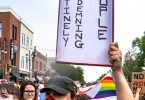
LGBTQ2S+ people of colour along with their allies blocked this year’s Pride Parade in Edmonton, and expressed four demands. One of them, uninviting the EPS, has caused a rift between the older generation of predominately white activists, and the younger generation of trans and people of colour activists.
The former assert they have gone through the era when police were hunting them down through bath house raids, and that they have lived through the AIDS crisis when society viewed gay men as lepers to be confined, isolated, and marginalized. They claim to have worked incredibly hard to build a relationship of trust with the police, which led to the creation of the sexual and gender minorities liaison committee (SGMLC) with the EPS. They feel the protest demanding exclusion of the police destroys all the bridge-building work they have done over decades.
The protesters assert that, while white middle class gay men have obtained their rights and revel in celebrations, many trans people and people of colour are subjected to a disproportionate amount of policing through carding, manhandling and incarceration, which makes them feel unsafe around the police. Many people of colour are not out and feel discriminated against in mainstream LGBTQ2S+ spaces. They feel such a protest was the only option they had left to be heard.
On the one hand is a concern that the LGBTQ2S+ community must feel free to report gay bashings and hate incidents. This necessitates working with the EPS, which should include officers from the diverse groups that make up our society including black, Muslim, Indigenous, and LGBTQ2S+ people of colour.
On the other hand is a protest that the EPS as an institution should be held accountable for disproportionately targeting vulnerable groups that include trans folk, people of colour, those with a disability and the economically disadvantaged. The protesters believe that disallowing the EPS entry into the parade would put pressure on the EPS to do better until the vulnerable groups feel safe.
However, there is a diversity of voices among trans folk and people of colour. Not all voices are in complete agreement with the protesters. This was evident through a video of the protest where a black protester told another black person “you are colonized.”
Additionally, in contrast to other protests where the oppressed stand in the face of tyrants and dictators or large corporations, this demand affects other LGBTQ2S+ people who have fought hard to be visible in their jobs with the police and the military. This is one reason why this particular demand has caused a rift in the community.
Some protesters are not actually out in their respective ethnic and religious communities. For them, marriage equality is inconsequential, for often their concerns revolve around health care, discrimination in the job market, experiences of rejection and racism on dating apps, and the like. Some of them do not seem to have had success on affirmation in their general ethnic and religious communities.
They have however nurtured a jargon that includes slogans like “shut up and listen,” “I am not doing emotional labour,” “check your privilege,” and “sit the fuck down.” Such strongly-worded language allows them to vent frustrations just as it alienates others.
In contrast, many straight black, African, South Asian, Indigenous, Chinese, Jewish, and Muslim communities consistently work with the EPS through their respective liaison committees to address racism, Islamophobia, hate incidents, and hate crimes.
They recognize that change requires leadership, which comes through humility, patience, willingness to engage in conversation, and a genuine regard for community. Indeed, in a climate of Islamophobia which has manifested in Alberta—through angry outbursts at Denny’s in Lethbridge, threats to Muslim women at the University LRT station, punish a Muslim day, anti-Muslim protest at a high school in Red Deer, etc.—Muslim communities cannot afford the tactics adopted by the protesters at the Pride Parade.
Now that the Edmonton Pride Festival Society accepted the protester’s demands, an objective metric—in contrast to subjective feelings—will have be devised to monitor if EPS initiatives have made people safe.
Rights are not usually given on a platter—they have to be worked for. If people have the strength to stall a parade with thousands of participants and observers, they have the requisite capacity to have difficult conversations, and eventually work with the EPS on instituting policy changes and other objectives.
Activism is based on strength and contribution, not perpetual victimhood. The response to racism and xenophobia is not alienation of supporters. In essence, real work requires recognizing that rabble rousing is just a one-day event, but sustained work on common ground is year round.
Junaid Jahangir



Leave a Comment X