
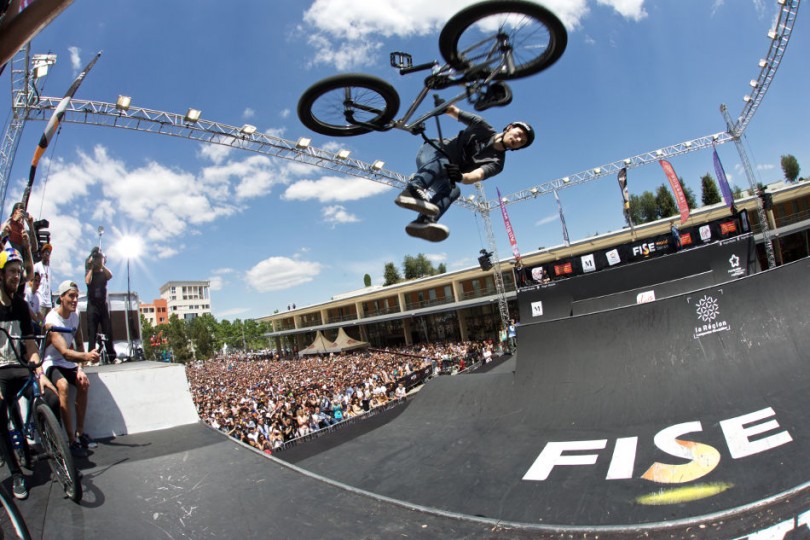
FISE World Series brings the best of action sports
There was a period in the early aughts where it seemed like every kid at school wanted to be an extreme athlete. They all wore D.C., Darkstar, or Element and had the entire soundtrack of Tony Hawk’s Underground memorized—which in effect, meant a lot of prepubescent headbanging to NOFX and The Adicts. Some of them stuck with it, and became so good that they’re now traveling the globe.
The Festival International des Sports Extremes World Series spans three continents, with over 2,000 amateur and professional athletes. After 20 years of skinned elbows, charley horses, and copious amounts of road rash, FISE is making a stop in Edmonton to celebrate melted rubber and splintered decks.
“It’s really a festival, it’s not just an event and it’s not just a competition,” says FISE World Series communication manager, Dominique Granger. “It really has a festival feel to it, so when you go, there’s a lot of activities on each of our stops. We have activities for the whole family. Of course, there is the action sports competitions to watch…It’s amazing to see what these guys and girls are doing out there on the park.”
Now fresh from the latest stop in Budapest, and now at the half way point of the competition, the FISE World Series has become a tighter race. BMX freestyle park and the mountain bike slopestyle rankings are nearly neck and neck.
It’s almost vulgar to deprive these sports of their magic and attempt to describe what they entail. Something like the BMX flatland seems to have more in common with the high styles of dance than cycling.
“The sport that is taking the most space for us in 2017 is probably BMX freestyle in the park, because it is now an Olympic discipline,” says Granger. “And the FISE is now working with the official U.C.I. BMX Freestyle World Cup, which means that the people that you see on the park, during our event, will mostly likely be the future Olympians. At least some of them, so it’s very exciting things for actions sports. We’re really part of something bigger.”
The contests are open to juniors and amateurs as well, though not the mountain bike course because as Granger notes, it’s tricky and it would be risky to let just anyone on it. There are also junior contests for any kids who want to shred the same parks as the professionals.
For those who get tired of watching people test nerves and helmet density, or are too small to grind a rail, the festival also provides some more family focused activities like archery tag, bumper balls, and strider races.
“What’s really important for us in the FISE is it’s not only an event for the teenagers, it’s really for the whole family,” says Granger. “So little kids, to adults, even elderly people. In China, you should see the crowds in China, we have really I think the oldest population who comes to watch the FISE, and they enjoy it so much. It’s almost like the circus with the people flipping upside down. Even if you don’t understand the sport itself, it’s really a fun thing to watch.”
FISE began in 1997, when then business student Hervé André-Benoit assembled one hundred riders to Palavas, France for the first ever FISE. Today, his hometown of Montpellier is still the center around which the festival orbits. Fittingly, the festival’s first stop in Montpellier attracted half a million people.
Now with the FISE World Series descending on Hawrelak Park, those adults who once wore skate clothes and blasted Bad Religion, along with their kids, get to see just how high melted rubber and splintered decks can take you.
“For me, to be able to make an event that is kid-friendly is really a big thing,” says Granger. “Those kids who are watching, if they’re not exposed to these sports, if they don’t know they exist, and if they don’t know what can be done, there’s no way they’re going to think like ‘Oh, I’m going to ride a skateboard, or a BMX, or a mountain bike eventually.’ Exposing the kids to this is really the best way to keep our sport going.”

Leave a Comment X